2006年VOA标准英语-US Commander Says Iraq Violence to Continue, Bu
搜索关注在线英语听力室公众号:tingroom,领取免费英语资料大礼包。
(单词翻译)
By Al Pessin
Washington
12 October 2006
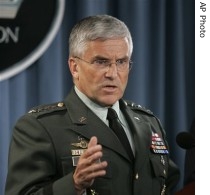 General George Casey |
||
-----
General Casey says he, his deputy and Iraqi officials are constantly reviewing their strategy and tactics, but he offered no specific plan for how to end the current wave of violence. "The operational strategy to deal with the increases in violence is something that I'm working very closely with Pete Chiarelli. The broad strategy, where we are working to bring the levels of the insurgency5 down as we bring the Iraqi security forces up, I believe, is still a valid6 framework for what we are doing there in Iraq," he said.
U.S. casualties in Iraq remain high, but General Casey said the violence has largely shifted from an anti-US insurgency to sectarian violence. Still, the general says he still believes Iraq is not in a civil war. "If you add the intensities7 of Ramadan and the fact that the new government is just standing8 up, this makes for a difficult situation that's likely to remain that way for some time. That said, violence and progress coexist in Iraq, and we shouldn't be distracted from the positive things that are going on there, amidst all the violence," he said.
Among those 'positive things,' General Casey cited progress in developing the new Iraqi Army and police forces, reforms in the Interior Ministry9 and the development of provincial10 governments so that two have already taken control of their areas and several more will do so by the end of the year. He also said the new prime minister is working hard on his national reconciliation11 effort.
General Casey disputed an article published in a British medical journal this week estimating that 655,000 Iraqi civilians13 have been killed in fighting since the U.S.-led invasion in 2003. He said the highest figure he has seen is 50,000, and other U.S. officials noted14 Wednesday that coalition forces work hard to minimize civilian12 casualties while the various insurgent15 groups target civilians deliberately16.
The general also noted that 80-to-90 per cent of the violence is within 50 kilometers of Baghdad. Still, he said the level of violence in Iraq is too high. "We shouldn't try to sugar-coat this. The levels of violence over the last few weeks are as high as they have been," he said.
Earlier, President Bush re-stated his determination to stick with the U.S. mission in Iraq, and he also said he is open to changing tactics if General Casey feels the need to. The two men met Wednesday morning. "What's important for the president is when I open up that door in there and General Casey walks in, he feels confident to tell me what's on his mind, Jim. 'Here's what's going right and here's what's going wrong and here's what we're doing about it.' And so, for those folks saying, you know, 'make sure there's flexibility,' I couldn't agree more with you," he said.
General Casey did not say what he told President Bush, or whether he has any major tactical changes in mind. But he noted that he cancelled his plan to begin substantial U.S. troop withdrawals17 by the end of this year. He also said recent efforts to reduce the violence in Baghdad have been successful, although they have not worked as quickly as he would have liked.
"We are not comfortable with the levels of sectarian violence in Baghdad, and neither is the Iraqi government. We're working with them to take measures to deal with that. The plan that we have in place in Baghdad has affected18 the levels of sectarian violence in Baghdad, (but) not as quickly as we would have liked," he said.
General Casey says the coalition and Iraqi forces are facing a multi-faceted enemy, ranging from Shiite militias19 to fighters who want the U.S. forces out to Sunni extremists who are supported by the Al-Qaida terrorist network. And he repeated administration complaints that Iran and Syria have been supporting some of those elements.
The general said he does not need more U.S. troops, at least for now. But he added that it is difficult to determine whether more troops would have a significant impact on the violence outside the specific area where they were deployed20. Some members of congress and other experts have called for sending more troops, but U.S. officials have said sending more troops could inspire more violence.


