2006年VOA标准英语-Desmond Tutu Discusses His Life as an Advocate
搜索关注在线英语听力室公众号:tingroom,领取免费英语资料大礼包。
(单词翻译)
By Amanda Cassandra
New York
19 October 2006
Nobel Prize winner and influential1 religious leader Desmond Tutu was in New York to talk about South Africa's struggle with apartheid and his personal path to becoming an activist2 as detailed3 in a new biography.
-----
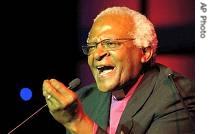 Desmond Tutu |
||
Tutu says he did not start out wanting to be a civil rights leader.
"I didn't at first think there was anything wrong with how things were organized," said Desmond Tutu. "This is how things are and so you have to accept it. It was my exposure to other people which began to move the shades from my eyes and I could then begin to see this wasn't right."
Allen describes meeting Tutu as a journalist in 1976 and perceiving him as a man who could unite all South Africans.
"The passionate7 intensity8 with which he spoke9 was so attractive to me as a journalist," said John Allen. "And then the other side was the compassion10, the reaching out to white South Africans. He had this extraordinary capacity to reach out and communicate with white South Africans."
Tutu says his strategy for galvanizing South Africans against apartheid was simple.
"It was fairly straightforward11 that one of the things we had to do was to seek to establish a moral position," he said. "The second was maintaining the morale12 of our people. Telling our people 'your cause is a just cause.' This is, in fact, a moral universe. We're going to win."
Tutu drew a parallel between the African American struggle for freedom in the United States and South Africa.
"It is like what happened here in the time of slavery, when you had the spirituals," said Archbishop Tutu. "People believing fervently13 that freedom was coming. It might not come in their lifetime, but it was coming. The faith community sustained the hope of the people. They knew that we were in a struggle and you say to them obviously in a struggle there are causalities."
Allen says the non-violent tactics Tutu employed were brave and difficult, but ultimately successful.
"People who call pacifists weak, that's not the case," he said. "Actually you go into confrontation14. You confront violent people without weapons and your confrontation draws out their violence as it did in Birmingham with the dogs as it did in South Africa with the dogs. And that worked beautifully in Capetown in those few months. It was called the Defiance15 Campaign. The police violence, which was normally confined to black townships, was exported into the city. There was a particular evening, in which the Anglican Cathedral went to a judge to seek an order to stop the police from beating people up indiscriminately on the streets. Well, the police lawyer had considerable difficulty persuading the judge not to grant the order when the judges own clerk had been beaten up on the way to court to hear the case that evening."
In 1984, Tutu was awarded the Nobel Peace Prize for his efforts to end apartheid in South Africa. Two years later, he became the first black Anglican Archbishop in South Africa.
Tutu and Allen discussed Tutu's life and Allen's book before a crowd of 700 at New York's historic Trinity Church on Wall Street.


