2006年VOA标准英语-Report Points to Regional Approach for Iraq
搜索关注在线英语听力室公众号:tingroom,领取免费英语资料大礼包。
(单词翻译)
By Gary Thomas
Washington
06 December 2006
The Iraq Study Group report paints a grim assessment1 of the situation in Iraq. Although it makes recommendations, it says those recommendations are by no means foolproof. As VOA correspondent Gary Thomas reports from Washington, the commission is suggesting the United States move to a regional, rather than unilateral, approach to stabilize2 the country.
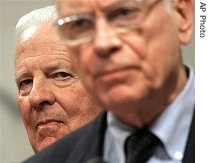 |
| Co-chairmen of the Iraq Study Group Lee Hamilton (r) and James Baker |
The report calls for a diplomatic offensive and the creation of an "Iraq International Support Group" that would include Iraq's neighbors, including Iran and Syria.
Larry Diamond, a former adviser5 to the Coalition6 Provisional Authority in Iraq and a consultant7 to the commission, tells VOA the group realized that all of Iraq's neighbors have both a role and a stake in seeing a stable government in Baghdad.
"It means recognizing that Iraq is embedded9 in a regional context which is feeding the descent into civil war and the polarization of the country internally," said Larry Diamond. "And unless all the regional actors are involved, or invited to become involved, to recognize their own stake in the stabilization10 of Iraq, the situation will likely not be stabilized11."
The report also calls on the United States to talk directly with Iran and Syria - something the Bush Administration has adamantly12 refused to do. Commission co-chair Lee Hamilton said that while that recommendation may strike some as controversial, such talks are the only way to get Damascus and Tehran to use their influence among warring Iraqi factions13.
"If you don't talk to them, we don't see much chance of progress being made," said Lee Hamilton. "You cannot look at this area of the world and pick and choose among the countries that you're going to deal with. Everything in the Middle East is connected to everything else. And this diplomatic initiative that we have put forward recognizes that."
But Larry Goodson, a professor of Middle East Studies at the U.S. Army War College, says it will be more difficult to deal with the government of Iranian hard-line President Mahmoud Ahmadinejad than his predecessor14, the reform-minded Mohammad Khatemi.
"Now I think it's going to be much harder to get Iran to play a constructive15 role, which doesn't mean that we shouldn't be trying to talk to them and build them into this support group," said Larry Goodson. "I'm just not sure that we can make this thing be successful because now you are asking countries in the region to really set aside their national interests in favor of an American-defined conception of their national interests vis-à-vis Iraq."
The report also calls for U.S. troops to be withdrawn16 from a direct combat role by 2008 and to embed8 U.S. military advisers17 with Iraqi units to train them. Nora Bensahell, a political scientist at the RAND Corporation, says the commission may be a bit too optimistic about that.
"The problem is that it's proved very difficult to train Iraqi army units," said Nora Bensahell. "Although that process has been going on and it has improved in the past few months, it still has an incredibly long way to go. There is a risk that by taking U.S. forces off combat patrols, which is what they're doing now, you will actually increase the levels of violence in the short to medium term, which could leave a gap while the U.S. is getting its efforts to increase its training efforts off the ground."
President Bush said Wednesday that neither he nor Congress will approve of all 79 recommendations. But Larry Diamond, now at the Hoover Institute at Stanford University, says selectively choosing which of them should be adopted may short-circuit the effort to stabilize Iraq.
"Well, it's unlikely that the administration is simply going to accept wholesale18 and without modification19 all 79 recommendations," he said. "But there is a kind of philosophical20 approach here that puts a heavy emphasis on internal negotiations21 for political reconciliation and constitutional compromise, and regional negotiations to foster that to create an enabling environment for stabilization in Iraq. And I'd say that if you start altering big pieces of the approach, it starts to break down pretty quickly."
The Bush Administration is conducting its own internal review of Iraq policy separate from the bipartisan Iraq Study Group's effort.
 收听单词发音


