2007年VOA标准英语-US Lawmakers Push to Open Holocaust Archive
搜索关注在线英语听力室公众号:tingroom,领取免费英语资料大礼包。
(单词翻译)
By Ivana KuharWashington
02 April 2007
Sixty two years after the end of the World War II, the largest Holocaust1 archives in the world still remain closed to the public. US lawmakers are now calling for the prompt release of the documents. For producer Ivana Kuhar, VOA's Jim Bertel reports from a recent hearing in the US Congress:
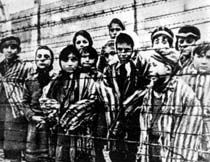 |
| Nazi2 concentration camp |
Bad Arolsen, a small village in central Germany, contains original Third Reich documents, which the Allies seized after defeating Hitler's regime, that detail Nazi persecutions.
The files, stored in thousands of filing cabinets in 6 buildings are more than 24 kilometers long and contain up to 50 million pages. The documents are a testament4 of what happened to over 17 million people - Jews, Roma, homosexuals, political prisoners, and others deemed undesirable5 by Hitler's National Socialist6 (Nazi) Party over its 12-year reign7.
The Chairman of the US Congressional Helsinki Commission, Representative Alcee Hastings, says opening the records is a "moral imperative": "It's beyond shameful8 that 62 years after the end of the World War [II], the Holocaust archives at Bad Arolsen remain the largest closed World War II era archives in the world."
Bad Arolsen archives are controlled by the International Tracing Service (ITC) of the Red Cross. The ITC is run by a commission of 11 countries. It was only last year that all commission members agreed to make the documents public. But, so far, only five countries have completed the complex legal process required to open the Bad Arolsen archives.
On Wednesday, (March 28th) Congressman9 Robert Wexler, the Chairman of the Subcommittee on Europe in the US House of Representatives, called on the governments of Germany, France, Luxembourg, Greece, Italy and Belgium to speed up the ratification of amendments10 needed to shed more light on the fate of Holocaust victims. "It is unconscionable that Holocaust Survivors11 and their families are facing this delay and are met with bureaucratic12 red tape when they seek to trace the true events of their families' history. Shamefully13, many survivors die each year without knowing the details of family members' deportation14, incarceration15 or death. The international community has a moral obligation to address this greatest of injustices16."
But even though the bureaucratic conditions for opening the Bad Arolsen archives have not yet been met, the archive is being readied for release.
About two-thirds of the massive record have been digitized and will be made available to Holocaust research centers around the world for public viewing. Experts expect the entire collection to be ready for release within a year.
The President of the Holocaust Survivors Foundation USA David Schaechter says 80,000 Holocaust survivors in America live in poverty. Schaechter told the Congressional hearing that opening up Bad Arolsen records would provide the survivors a chance to get restitution17.
Schaechter added that opening the archives would be a blow to modern day deniers who claim the Holocaust is a myth created after 1945, and that it was never documented as a historical event.


