2007年VOA标准英语-Glacier National Park Rapidly Losing Its Glacie
搜索关注在线英语听力室公众号:tingroom,领取免费英语资料大礼包。
(单词翻译)
By Jeff SwicordGlacier1 National Park, Montana
03 September 2007
National parks in the United States are revered2 for their natural beauty and wildlife. They are fragile ecosystems4 that are cared for and preserved for future generations. Because of their fragile nature, they are also places where scientists are beginning to see the effects of climate change or global warming. VOA's Jeff Swicord reports from Glacier National Park in the Western state of Montana.
Since the early 20th century, Montana's Glacier National Park has attracted visitors to the majestic5 beauty of its peaks and valleys. But today's visitor is witnessing a rapidly changing landscape.
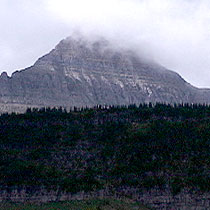
Glacier National Park
Dan Fagre is an ecologist with the U.S. Geological Survey, the government's earth and biological science organization.
"The namesake glaciers6 for Glacier National Park are disappearing rapidly," he said. "Especially in the last several decades. These glaciers that numbered 150 when the park was first formed are now less than 27."
More than 7,000 years ago, glaciers 900 to 1,500 meters thick covered this landscape. The constant ice flow carved out these jagged peaks and deep valleys.
 |
| Dan Fagre |
Now, Dan Fagre says the remaining glaciers are melting at an alarming rate. He blames global warming. "One glacier by itself can not invoke7 climate change. But, when you have all the glaciers in almost all of the mountain ranges of the entire globe responding the same way, then you know you have global phenomena8. And in this case, the glaciers are responding to warming."
Fagre says if the current melting trend continues all of the glaciers will be gone within 20 years.
"Just below the clouds is Salamander Glacier," he said. "It is a long thin dirty glacier with a waterfall pouring off it. And that use to be joined to Grinnell Glacier, which is much larger. And it came all the way down to the top of the double waterfalls. It was a thousand feet high when it was discovered in 1887."
This is grizzly9 bear country. Surprising one along the trail can be a fatal mistake. Hikers often make noise to let the bears know they are in the area. Today, Glacier National Park is a stunningly10 rich ecosystem3 with a myriad11 of unique plants and animals. That could change if the glaciers and dense12 winter snow pack disappear.
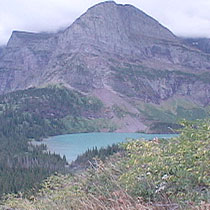 |
The water supply that feeds this mountain ecosystem is drying up, which is what happened to this dry creek15 bed. Some of these high altitude lakes are rich with Bull Trout16, a hearty17 species that can only survive in the cold glacial waters. Their habitat is also in danger.
Scientists say change has always been a part of life on Earth and many species have survived dramatic change over thousands of years. But Dan Fagre says this time will be different.
"What is different now is that we have these national parks that are these protected areas that are changing rapidly in many cases. But, the organisms don't have anywhere else to go," he said. "The landscapes outside these parks have been converted to other uses by humans."
Fagre believes in the long run, the earth will adapt to climate change. As for the U.S. national parks, they will probably survive but their landscapes and wildlife will not be same as before.
 收听单词发音


