2007年VOA标准英语-On Iraq Visit, Bush Pushes Iraqis to Work Toget
搜索关注在线英语听力室公众号:tingroom,领取免费英语资料大礼包。
(单词翻译)
By Al PessinAl-Asad, Iraq
04 September 2007
One of the main purposes of President Bush's surprise visit to Iraq Monday, along with his secretaries of State and Defense1 and senior military commanders, was to push Iraqi leaders along the difficult road toward political reconciliation2. VOA's Al Pessin was at the remote, desert air base in al-Anbar Province where the meetings took place. He filed this report on the president's effort.
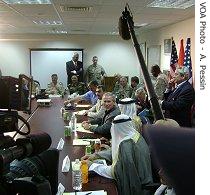 |
| U.S. President Bush and Iraqi leaders gather in al-Anbar, 03 Sep 2007 |
It took a visit from the president of the United States to get these Sunni, Shiite and Kurdish Iraqis together in one room. The president's message was that they have to work together in spite of their different backgrounds and ingrained distrust.
"They're here in Anbar because they know the success of a free Iraq depends on the national government's support from the bottom up," said President Bush. "They know what I know, that when you have bottom-up reconciliation like you're seeing here in Anbar, it'll begin to translate into central government action."
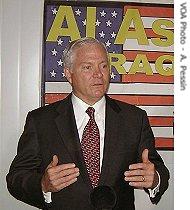 |
| Robert Gates speaks to reporters in Iraq, 03 Sep 2007 |
"There was I think a good feeling, and each of the elements - there were also some military in there, we had the provincial governor there, we had the sheikhs and we had the national leaders - and I would say that there was a sense of shared purpose among them, that they were all in this together," he said. "And then there was what I considered some good-natured jousting7 about resources, and who's going to get what."
The question remains8 whether the Iraqi leaders will continue to work together without President Bush at the table. U.S. officials say that is essential to solidify9 gains made by the surge of U.S. forces and the counterinsurgency strategy.
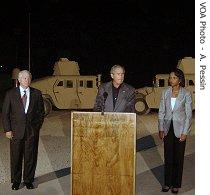 |
| U.S. President Bush (center), speaks to reporters in al-Anbar, Iraq, with Defense Secretary Robert Gates (l) and Secreatary of State Condoleeza Rice (r), 03 Sep 2007 |
"It was said explicitly11 today that for the first time, a Middle Eastern people got to see what rule by al-Qaida would be like, and the Iraqis rejected it," said Secretary Gates.
Earlier, a senior official traveling with Secretary Gates, speaking on condition of anonymity12, had called the tribal sheikhs' turnaround "unexpected" and "almost serendipitous13."
But other officials, including President Bush, later rejected that characterization, saying the surge of 4,000 U.S. Marines in Anbar several months ago was designed, in part, to convince the tribal leaders that the coalition14 is committed to defeating al-Qaida.
Now, the U.S. officials say, it is up to the Iraqi government to move the reconciliation process forward, in Anbar and elsewhere, to create more security and stability, and allow for the withdrawal15 of U.S. troops.
Many members of Congress are calling for the withdrawal to start by the end of the year, but combat commanders have said that would be too soon. President Bush said Monday if current trends continue, a withdrawal will be possible, but he did not say when. He is expected to expand on his view after key testimony16 before Congress next week by two men he met with on Monday - U.S. Ambassador to Iraq Ryan Crocker and the top U.S. military commander in the country, General David Petraeus.
 收听单词发音


