2007年VOA标准英语-Iraqi President: Sectarian Factions Beginning t
搜索关注在线英语听力室公众号:tingroom,领取免费英语资料大礼包。
(单词翻译)
By Jim RandleIrbil, Iraq
07 September 2007
Recent reports to the U.S. Congress about the situation in Iraq point to limited success by the Iraqi government in establishing security but continuing problems in bringing about political reconciliation1. As VOA's Jim Randle reports from Irbil, Iraqi President Jalal Talabani says he believes the various sectarian factions2 are starting to work together.
Recent reports by U.S. experts say Iraq's government has been stymied3 by bickering4 and walkouts, impeding5 the progress necessary for political reconcilation and an end to the four-year-old war.
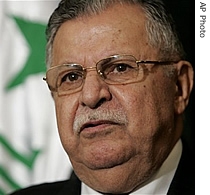 |
| Jalal Talabani (file photo) |
Iraq's president told journalists in Sulaimaniya that Iraqis are making progress toward reconciling the various political groups. Mr. Talabani said this is good for Iraq's future. As far as the walkout by many members of Iraq's cabinet, he called that a normal part of the game of politics in a democracy.
Mr. Talabani's remarks come days before the top American military commander in Iraq, General David Petraeus, and the U.S. ambassador to Iraq, Ryan Crocker, give a crucial report to President Bush and the U.S. Congress on progress and problems in the country.
That assessment will help guide decisions on whether to maintain or reduce current U.S. troop levels.
While President Talabani is striking an optimistic note, analyst7 Brian Katulis of the Center for American Progress says the country has been in the process of "political fragmentation."
"A lot of the forces that were elected in 2005 were elected by forces that did not support a strong center," he said. "In many ways there's fundamental disagreement among Iraq's leaders about what the country is and what it should be."
In a just-published report, the International Crisis Group says the situation in Iraq became even more unstable8 during August. It called the country ungoverned and violent, and noted9 that the recent bombings in Yazidi villages in northern Iraq that killed about 500 people were the deadliest attack since the 2003 U.S.-led invasion.
The group's Joost Hiltermann says Iraq's bickering factions are not likely to resolve their differences.
"We recommended that we move to a different level, that we move to the regional level and that there be real engagement between Iraq's neighboring states, and those states and the United States," he said.
Hiltermann says those talks should include direct discussions between Washington and Iran and Syria. The United States has strained relations with Syria and accuses Iran of supplying weapons to insurgents10 in Iraq who have attacked U.S. forces.
It is unclear what General Petraeus will tell Congress when he testifies next week. Some reports say he may recommend a gradual reduction of a small number of U.S. troops beginning next spring.
There are currently 168,000 U.S. troops in Iraq, including 30,000 that were deployed11 for the "surge" aimed at stabilizing12 Baghdad and restive13 al-Anbar province.
 收听单词发音


