2007年VOA标准英语-Israelis Mark Jewish New Year Amid Regional Ten
搜索关注在线英语听力室公众号:tingroom,领取免费英语资料大礼包。
(单词翻译)
By Robert BergerJerusalem
12 September 2007
Israelis are observing the Jewish New Year, Rosh Hashanah, one of the holiest days on the Hebrew calendar. As Robert Berger reports from VOA's Jerusalem bureau, the holiday season takes place against the background of growing tension on Israel's northern and southern borders.
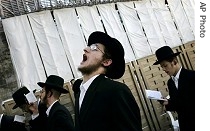 |
| Ultra-Orthodox Jewish men pray at Western Wall, Judaism's holiest site, in Jerusalem's Old City, 12 Sep 2007 |
But the holiday season has been overshadowed by escalating1 tensions between Israel and its northern neighbor, Syria. A week ago, Syria said its air defenses fired on Israeli warplanes that violated its airspace. And now, media reports are emerging with details of the incident.
The reports say Israel launched an air strike deep inside Syria, targeting weapons supplies from Iran or a missile base. The New York Times said Israeli jets recently spotted2 possible nuclear facilities in Syria. Israeli officials have not commented, but the reports have raised fresh fears of another Mideast war.
 |
| Israeli soldiers unload a large group of detained Palestinians from a truck following an army operation in the Gaza Strip, 06 Sep 2007 |
The High Holy Days are a time of reflection, so recent events are weighing on the minds of Israelis. Barry Mevorach immigrated4 to Israel from New York a few years ago. He spoke5 to VOA about his concerns.
"I don't think we're going to see peace," he said. "I think we're going to see an increase of violence on the northern border, an increase in the Gaza area."
And tensions on two fronts make many Israelis nervous.
"There's such a division in the north area and in the Gaza area that the dilution6 of the military strength is something that we've got to be very concerned about in Israel at this time," he noted7.
Despite these concerns, Israelis dip apples into honey on Rosh Hashanah, a tradition symbolizing8 hope for a sweet new year.
 收听单词发音


